Why Most Homeschool Plans Fail (What to Do Now)
We may earn money or products from the companies mentioned in this review or post, but all opinions are our own.
If you’ve ever created a homeschool schedule that looked great on paper but quickly fell apart, you’ve probably wondered why homeschool plans fail so often. You’re not lacking discipline or effort—most parents are working incredibly hard to make things work.
The real issue is that many homeschool plans are built on structure alone, without the foundation needed to support real family life. When you understand what’s missing, you can finally build a plan that feels sustainable, flexible, and successful.
You Started With a Plan… So Why Isn’t It Working
At the beginning, you had a plan.
You chose curriculum.
You set a schedule.
You felt ready to do this well.
But somewhere along the way…
Things started slipping.
The routine didn’t stick.
Your child pushed back.
The days felt harder than they should.
And now you’re wondering:
“Why isn’t this working?”
If you’ve asked that question, you’re not alone.
Most homeschool plans don’t fail because parents aren’t trying hard enough.
They fail because they’re built on the wrong foundation.
The Real Reason Homeschool Plans Fall Apart
Most homeschool plans are built around:
- subjects
- schedules
- expectations
But they’re missing something essential:
A foundation that actually supports your family.
When that foundation is missing, everything feels harder than it should.
You try to fix it by:
- adjusting the schedule
- switching curriculum
- adding more structure
But the problem isn’t what you’re doing.
It’s where you started.
Mistake #1: Starting With Structure Instead of Connection
It’s natural to think:
“If I just get the routine right, everything will fall into place.”
But if your child feels:
- disconnected
- pressured
- misunderstood
No routine will fix that.
Connection isn’t extra.
It’s the starting point.
Without it, even the best plans feel like a struggle.
If you end your homeschooling experience without a great relationship with your child, your time was wasted. It sounds harsh, but I stand by it. As a second-generation homeschooler who survived the 90s, I have seen countless parents prioritize all the wrong things.
They don’t have a crowded table at Thanksgiving. They are waiting by the phone for kids who will likely never call.
Relationships are vital for building trust. A kid who trusts that you have their best interests in mind is a kid who will follow through on a task because you asked.
Mistake #2: Copying a System That Was Never Meant for You
It’s easy to look at another homeschool and think:
“That’s what we should be doing.”
But what works for someone else:
- fits their schedule
- fits their child
- fits their priorities
When you try to copy it, it often creates more stress—not less.
Because it doesn’t fit your life.
Homeschooling was our opt-out from the system that failed to meet our needs. Your homeschool is a tool to help you reach the goals you have for your family. Your goals are different from mine. They are different from any other family, and that is the point.
You get to create a learning system that fits all of you and helps you find daily wins!
Mistake #3: Skipping Your “Why”
When things get hard (and they will), your plan needs something deeper than structure to hold it together.
It needs direction.
Without a clear “why,” it’s easy to:
- second-guess everything
- change course constantly
- feel like you’re always behind
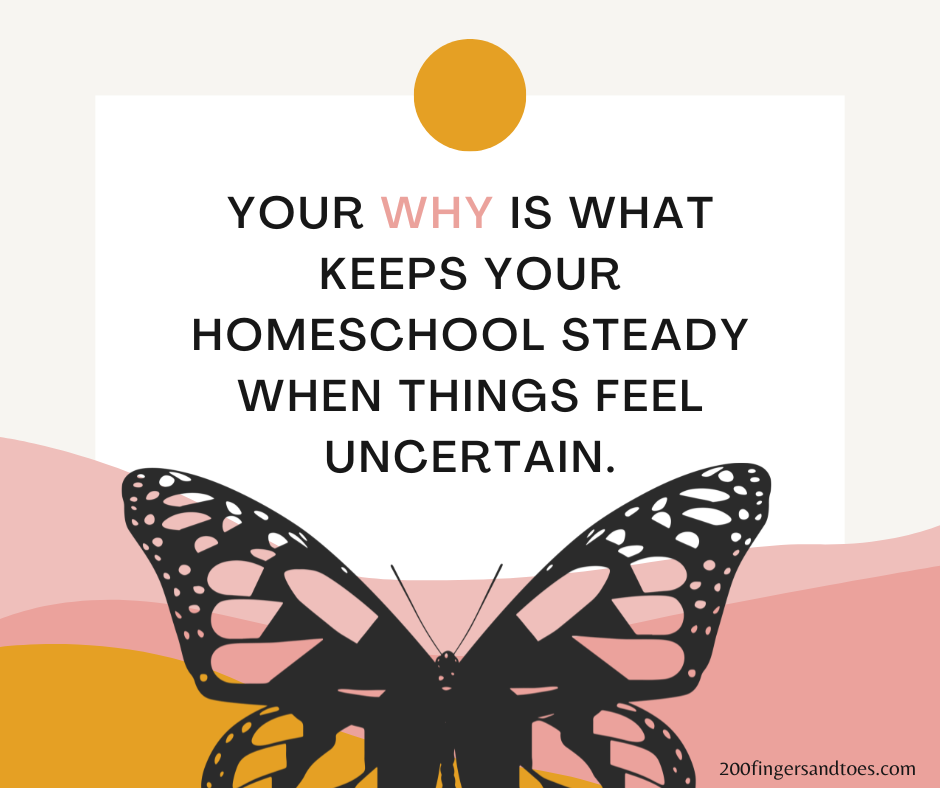
Your “why” isn’t just a nice idea.
It’s what keeps your homeschool steady when things feel uncertain.
Can I let you in on a little secret? I wrote my homeschool WHY by accident. There was a window in the setup section of a record-keeping app I was using. It asked for your homeschool vision. I didn’t have one.
The little window sat there blinking at me, so I made one up.
That little statement has saved my life on so many days when I wanted to quit. I printed it and put it in my homeschool notebook. Trust me when I say, you need a why statement.
Mistake #4: Trying to Do Too Much
This is one of the most common traps.
You want to do it well—so you try to do everything.
More subjects.
More structure.
More expectations.
But more doesn’t create better outcomes.
And overwhelm leads to burnout—for you and your child.
Start smaller than you think. Start with fewer planned activities and hard timelines. Give yourself flexibility and space to make shifts both big and small. You can always add on throughout the year, but there is nothing more defeating than wasting money from the outset of your homeschool experience.
Give your family time to learn about HOW they learn best.
What to Do Instead: Build From the Inside Out
If you want a homeschool plan that actually works, flip the process.
Instead of starting with structure…
Start with what matters most.
1. Start With Connection
Before you adjust anything else, strengthen your relationship with your child.
Learning flows best when trust is present.
2. Define What Success Looks Like for YOUR Family
Not someone else’s version.
Ask:
- What do we actually want this year to feel like?
- What matters most?
- What are we willing to let go of?
3. Create a Simple, Flexible Routine
Not a rigid schedule.
A rhythm you can return to—even when life gets messy.
4. Build a Plan You Can Adjust
Because things will change.
And that’s not failure.
That’s real life.
If Your Current Plan Isn’t Working, Start Here
If you’re feeling like your homeschool plan isn’t working the way you hoped…
Don’t scrap everything.
Reset it.
👉 The 5-Day Homeschool Reset Plan walks you through exactly how to:
✔ Rebuild connection
✔ Let go of comparison
✔ Clarify your direction
✔ Simplify your routine
✔ Create a plan that fits your family
You can download it here:
You Don’t Need a Better Plan—You Need the Right One
Most homeschool parents don’t fail because they aren’t capable.
They struggle because they were never shown how to build something that actually fits their life.
That’s why I wrote:
The Six Keys to Your Successful Homeschool Year
This isn’t a rigid system.
It’s a step-by-step guide to help you:
✔ Build a homeschool around your family’s values
✔ Strengthen your relationship with your child
✔ Create a plan you can actually follow
👉 Get your copy of The Six Keys to Your Successful Homeschool Year now
Final Thought
If your plan isn’t working, it doesn’t mean homeschooling isn’t right for you.
It just means it’s time to build something better.
And you can.