The Marriage Portrait Review: The Best Historical Fiction this Year
We may earn money or products from the companies mentioned in this review or post, but all opinions are our own.
By Maggie O’Farrell | Historical Fiction | ★★★★★ 5/5 Stars
If you’re looking for an honest The Marriage Portrait review, I can tell you right away that this beautifully written historical fiction novel earned an enthusiastic five stars from me. With its unforgettable young heroine, richly imagined Renaissance Italian setting, and suspenseful story, it had me looking forward to my workday just to keep listening; this book delivered everything I love about historical fiction.
Sometimes the best books are the ones you stumble upon when you aren’t even looking for them. That’s exactly how I discovered The Marriage Portrait by Maggie O’Farrell. I was scrolling through the audiobooks available right now in my Libby app when the beautiful cover caught my eye. I enjoy classical art, so naturally, I was intrigued. I knew absolutely nothing about the story, and I’d never read Maggie O’Farrell before. A few days later, I had finished one of my top reads of 2026, discovered a new favorite author, and found myself wishing there were just a few more chapters.
What Is The Marriage Portrait About?
The Marriage Portrait follows Lucrezia de’ Medici, a young daughter of a wealthy and powerful Italian family during the Renaissance.
As a younger daughter, Lucrezia isn’t necessarily expected to secure the family’s most advantageous marriage. But when her older sister dies, Lucrezia suddenly finds herself promised to the man who was intended to marry her sister: Alfonso, Duke of Ferrara.
Lucrezia is barely more than a child when she enters a marriage that will determine the course of her life.
Her new husband is charming, attentive, and seemingly understanding of her curious nature. But beneath the beautiful clothes, elaborate palaces, and political maneuvering of Italian court life, something far more sinister is developing.
The novel opens with Lucrezia sitting down to dinner with her husband and realizing that he intends to kill her.
First of all, HELLO.
What a crazy way to introduce a story!
From those opening paragraphs, I was completely captured. Here was this young, gentle woman, barely beginning her adult life, who believed her husband intended to murder her.
Why? What could possibly have brought them to this moment?
I had to know.
Lucrezia: A Historical Fiction Heroine I Absolutely Loved
One of my favorite things about The Marriage Portrait was Lucrezia herself.
From the beginning, Maggie O’Farrell gives us a wonderfully spirited young girl. Lucrezia is curious, intelligent, stubborn, and hungry to discover the world around her.
She’s not particularly interested in remaining within the boundaries prescribed for young women of her position.
She wants the freedom to explore. She is quick to learn. She wants to ask questions and discover things for herself. As her poop parents discover, she’s not terribly afraid of authority.
As a child, Lucrezia openly defies her parents, sneaks into places she isn’t supposed to be, and pursues interests that don’t necessarily align with her family’s expectations.
I loved her immediately. ( I may have raised a girl a little like her, but she crawled under horses instead of petting tigers)
In fact, she also reminded me of some of my favorite spirited literary heroines.
If you loved Anne Shirley from Anne of Green Gables, you’ll recognize some of that same curiosity and exuberance in Lucrezia. If you grew up thinking Pippi Longstocking was absolutely fantastic, you’ll probably appreciate Lucrezia’s willingness to push boundaries.
I was also reminded of Meg from The Calamity Club. Both characters have that youthful energy and independent spirit that make them so enjoyable to follow.
Of course, Lucrezia’s circumstances are considerably darker.
And that’s where O’Farrell’s character development becomes especially important.
The Qualities That Make Lucrezia Difficult Also Make Her Strong
One thing I kept thinking about long after finishing this book was how carefully O’Farrell develops Lucrezia’s childhood.
At first, her curiosity and defiance simply make her a charming character. But as the story progresses, those same qualities become essential to her survival.
Lucrezia is accustomed to questioning authority. She’s observant. She’s intelligent. She’s willing to look beyond the explanations she’s given.
And when she begins to recognize the danger surrounding her, those qualities give her something incredibly valuable: the determination not to surrender.
I loved that about her.
A Marriage Built on Power, Expectations, and Fear
One of the most frustrating aspects of this story is watching Lucrezia’s family arrange her marriage.
She’s so young. Her nursemaid recognizes this and attempts to delay the marriage, giving Lucrezia a little more time to remain a child. I was completely on the nursemaid’s side.
Meanwhile, Lucrezia’s mother seems eager to see the marriage proceed. I couldn’t help wondering whether part of her motivation was simply to see this wild, difficult daughter settled into another household.
But Alfonso initially gives us reasons to hope that things might turn out well.
He sends Lucrezia thoughtful gifts that acknowledge her interests in animals, art, and learning. His attention suggests that he might understand something about the unusual young woman he’s bringing into his household.
Perhaps this could become a good marriage.
Perhaps he might appreciate her curiosity and intelligence.
Of course, we’re reading all of this with the knowledge that the book opens with Lucrezia believing her husband intends to kill her.
And that creates such an interesting tension. You want to believe the best about Alfonso, even as you wait for the other shoe to drop.
When Lucrezia Begins to See Alfonso Differently
There is a particular scene involving Alfonso’s treatment of a young servant that completely changed how I viewed him.
Without going into too much detail, it’s one of the first moments when Lucrezia witnesses the cruelty he’s capable of.
What disturbed me most wasn’t simply his willingness to hurt someone. It was his ability to use another person to carry out that violence while he watched with approval.
Up until this point, Lucrezia has grown up in a household where servants were treated with a degree of familiarity and consideration.
Suddenly, she’s seeing an entirely different expression of wealth and authority.
And as a reader, I remember thinking, Oh gosh. She really is in danger.
O’Farrell handles this transition beautifully. The charming man who sends thoughtful gifts begins to reveal another side of himself, and Lucrezia must learn how to navigate a household where she has very little power.
The Marriage Portrait Explores the Value of a Woman Beyond Her Marriage
One of the strongest themes in The Marriage Portrait is the limited control women had over their own lives.
Lucrezia is born into extraordinary wealth and privilege, but those advantages offer surprisingly little protection when her marriage becomes dangerous.
Her value to her husband is tied closely to her ability to produce an heir.
Her family’s expectations are tied to marriage, alliances, and position.
Even when she appeals to the people who should protect her, she encounters opposition.
I found this especially heartbreaking.
Lucrezia recognizes that she’s in danger. She tries to reach people who might help her, but everywhere she turns, she hits another brick wall.
Her family seems unable or unwilling to recognize how serious her situation is.
Perhaps they still see the dramatic, unruly child she once was rather than the young woman desperately asking for help.
But Lucrezia doesn’t give up.
As her circumstances become increasingly frightening, she becomes more observant, more careful, and more determined to find a way forward.
And I think that’s what stayed with me most.
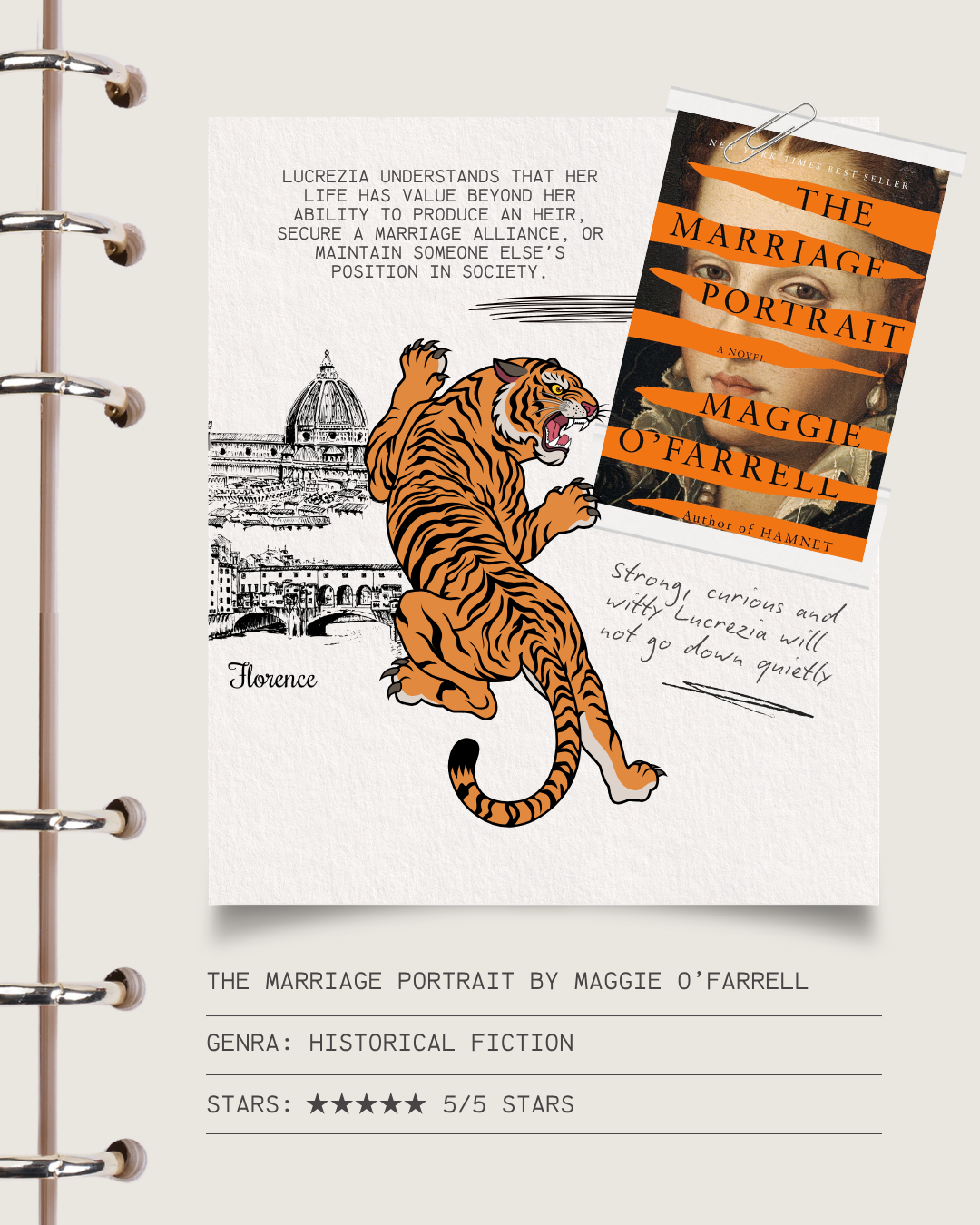
Lucrezia understands that her life has value beyond her ability to produce an heir, secure a marriage alliance, or maintain someone else’s position in society.
She has her own inherent worth.
And she’s willing to fight for it.
Maggie O’Farrell Brings Renaissance Italy to Life
One reason I love historical fiction is that it brings to life the places and time periods we otherwise encounter only through history books.
Dates, names, marriages, and political alliances can feel so distant when we’re simply reading about them.
But a gifted historical fiction writer can make those people and places feel real.
Maggie O’Farrell does exactly that.
I could almost feel the cold stone hallways of the Italian palaces. I could imagine the vast corridors, the elaborate rooms, and the strange emptiness Lucrezia encounters as she explores her new home.
O’Farrell also gives readers a wonderful sense of the differences between social classes and the expectations placed on everyone within these powerful households.
Nothing felt like unnecessary historical decoration.
Every detail contributed to the atmosphere, the characters, or the story itself.
And I loved that.
The Art Behind The Marriage Portrait
Since classical art was what initially attracted me to this book, I especially enjoyed the role painting plays in the story.
One fascinating thing about historical portraits is how little we often know about the people represented in them.
We might know their names, their family connections, whom they married, and when they died.
But who were they?
What did they love? What frightened them? What were their personalities like? What dreams did they have that never made it into the historical record?
The Marriage Portrait is inspired by the real Lucrezia de’ Medici, who died as a teenager.
From the surviving fragments of her history, O’Farrell imagines an entire personality, childhood, and inner life.
I think that’s one of the wonderful opportunities art offers us.
Every time we encounter a portrait, we can look beyond the beautiful clothing, the artist’s technique, and the historical details.
We can ask deeper questions about the person looking back at us.
And I love that Maggie O’Farrell has done exactly that with Lucrezia.
Is The Marriage Portrait Audiobook Worth Listening To?
Absolutely!
I listened to The Marriage Portrait through Libby, and the audiobook was a wonderful experience.
One of the things I appreciated most was how clearly Lucrezia’s personality came through in the narration.
Her voice felt youthful, bright, and hopeful.
Even as her circumstances became increasingly difficult, I never lost that sense of curiosity and determination that made me love her from the beginning.
I listen to audiobooks while I work, and I found myself genuinely looking forward to starting my workday because I wanted to hear more of this story.
It took me only a couple of days to finish.
And I was disappointed when it ended.
Not because I disliked the ending, but because I wasn’t ready to leave Lucrezia behind.
I wanted to know more about her life and what might happen beyond the final pages.
In fact, I enjoyed this audiobook so much that I immediately went looking for more Maggie O’Farrell novels. I continued with Hamnet and another of her books, both of which I also enjoyed in audio.
Finding a new favorite author is one of my favorite things about reading, and this was certainly one of those discoveries.
Who Should Read The Marriage Portrait?
I think The Marriage Portrait will appeal to a wider range of readers than you might initially expect.
If you love strong female characters: Lucrezia has that wonderful independent spirit I associate with Anne Shirley and Pippi Longstocking. She’s curious, stubborn, imaginative, and unwilling to simply accept the world as she’s told it must be.
If you love historical fiction: O’Farrell creates a richly detailed picture of Renaissance Italian life, from the beautiful palaces to the political expectations surrounding marriage and inheritance.
If you enjoy suspense: The opening creates an immediate question that hangs over the entire story. If you enjoy the uncertainty and tension of books like The Housemaid, you might appreciate the suspense woven throughout this historical novel, even though the books are quite different in style.
If you love character-driven fiction: This is where I think O’Farrell truly excels. Lucrezia’s personality, childhood, relationships, and changing understanding of the world are central to the story.
Readers looking for something lighthearted should know that the novel includes disturbing moments involving cruelty, coercion, and the vulnerability of a young woman trapped in a dangerous marriage.
But for readers who appreciate intelligent, emotionally engaging fiction, I think this book offers so much.
My Final Thoughts: A Five-Star Read
★★★★★ 5 out of 5 stars
As I look back over my 2026 reading list, which is approaching 100 books, The Marriage Portrait easily earns a place among my top five reads of the year.
And I don’t say that lightly.
I was captivated from the opening paragraphs, and I never reached a point where the story felt slow or the details seemed irrelevant.
Everything O’Farrell included added something to the characters, the atmosphere, or the unfolding story.
I loved Lucrezia’s curiosity. I admired her determination. I appreciated the rich historical setting and the way O’Farrell brought a young woman from a centuries-old portrait to life.
But more than anything, I loved Lucrezia’s refusal to surrender her sense of self.
She lived in a world where nearly everyone around her measured her value by her position, her marriage, and her ability to produce an heir.
Yet she recognized something greater in herself.
She valued her own life, her curiosity, her intelligence, and her freedom.
And she was willing to fight for them.
This is one of those books I keep returning to in my thoughts long after finishing it.
What started as a random audiobook selection from Libby turned into one of my favorite reading experiences of the year.
And I came away with something else wonderful: a new favorite author.
If The Marriage Portrait has been sitting on your reading list, I wholeheartedly recommend moving it closer to the top.
The Marriage Portrait FAQ
Is The Marriage Portrait based on a true story? Yes. Maggie O’Farrell’s novel is inspired by the historical Lucrezia de’ Medici, who married Alfonso II d’Este and died young. The novel imagines her personality, experiences, and circumstances, so it should be read as historical fiction rather than a factual biography.
Is The Marriage Portrait a romance? Although marriage is central to the plot, the novel is primarily historical fiction exploring power, identity, survival, and the limited choices available to women in Renaissance Italy.
Is The Marriage Portrait a thriller? It isn’t a conventional thriller, but the opening establishes a strong sense of danger and suspense that continues throughout the novel.
Should I read Hamnet or The Marriage Portrait first? Both are standalone novels. The Marriage Portrait is an excellent starting point for readers who enjoy suspense and strong female protagonists, while Hamnet is especially suited to readers interested in family relationships, grief, and literary historical fiction.