My 13 Character-Driven Greek Mythology Books for New Myth Lovers
We may earn money or products from the companies mentioned in this review or post, but all opinions are our own.
Character-driven Greek mythology books are the perfect doorway into the ancient myths. So many great Mythology books have been written in the last few years. There is no shortage of books to choose from. The greater problem is knowing which is best for a beginner who wants to fall in love with Mythology.
I’ve made it simple and chosen the best books for you. They dive into complex and compelling characters. These books offer fresh takes and new perspectives on the Greek gods. This immediate familiarity with the characters makes picking up a book by even an unknown author much more fun! The risk is gone.
I am far more interested in complicated characters than in memorizing gods, battles, and tangled family trees. These 13 stories are filled with fierce women and flawed heroes. ImReaders can relate to the familiar themes; difficult marriages, devastating betrayals, and characters trying to claim some control over lives shaped by fate.
These Books are Great for Everyone Because They Start with Familiar Characters
If you are a Greek Myth nerd, you are going to love these retellings and expanded point-of-view fictions. But you do not need to be a mythology expert to begin.
Why are these books a great starting place for beginners?
The familiar Greek landscape saves time that would normally be spent on world-building. This lets you get right to the character action.
Greek Myths are not for the faint-hearted reader.
Many of these tales are heart-wrenching; some Greek gods are cruel, laying open stories filled with injustices. These mythologies represent the full scope of the human condition.
The Greek gods played with humanity. These fabulous new authors play with their narratives. They highlight character attributes and shed light on the minor players.
Zeus, the alarming predator; Hera, a cruel step-parent. Their children and the humans they interact with offer a rich tapestry of emotional and unexpected turns.
What you will love…
Emotionally rich stories about family, loyalty, grief, and ambition. The choices that define us. These approachable retellings steeped in character-driven Greek mythology will help you meet the unforgettable faces behind the legends.
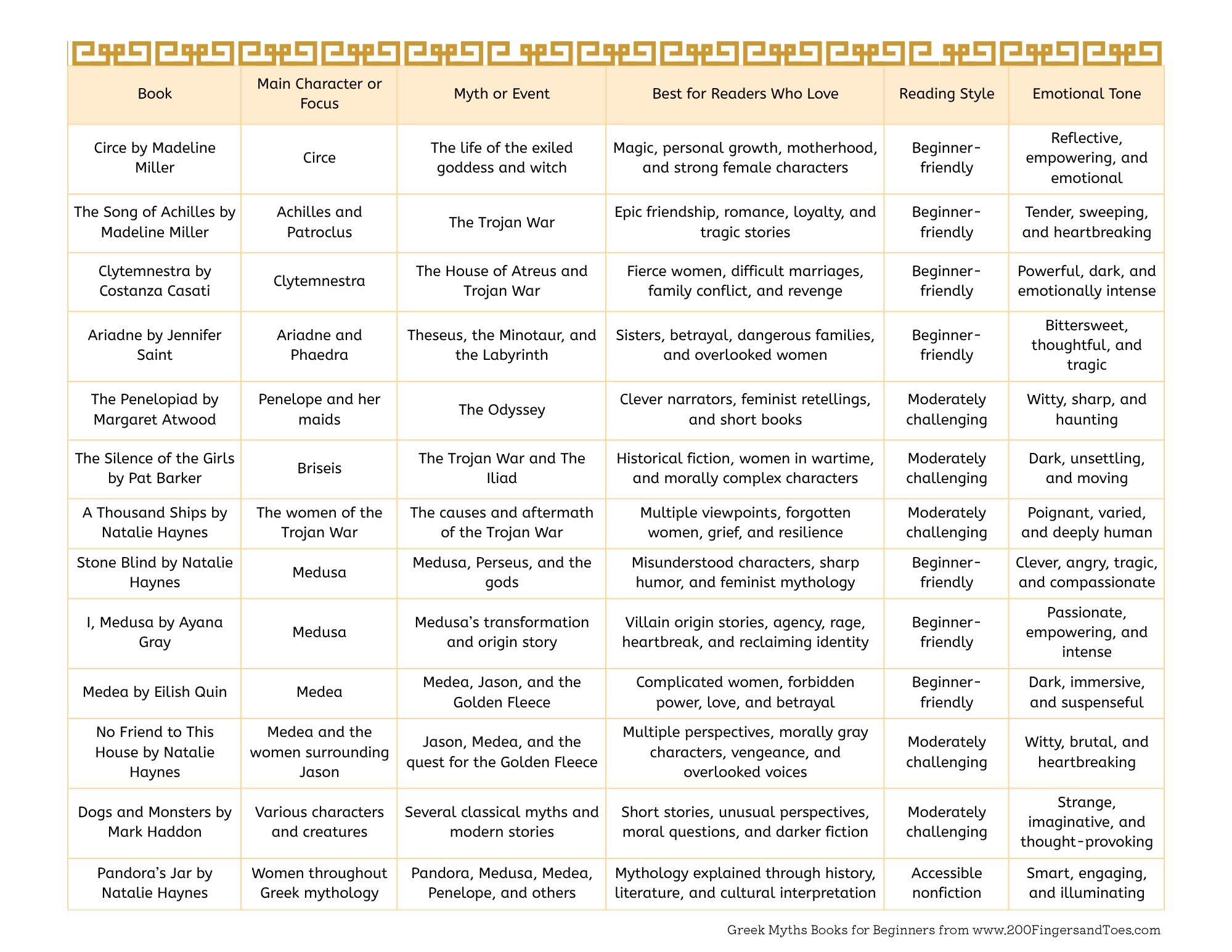
The Best Greek Mythology Books for Beginners at a Glance
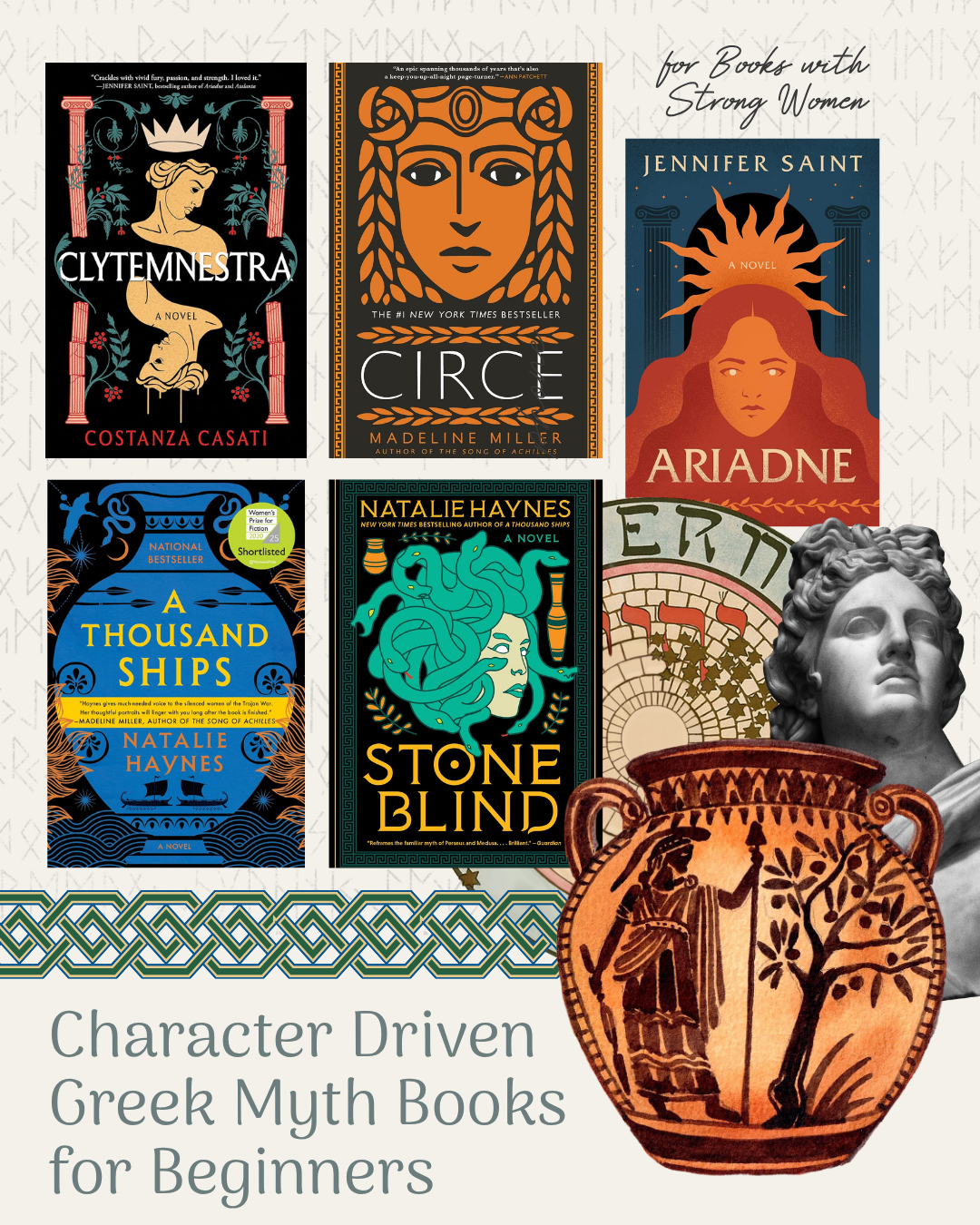
The best Greek mythology books for beginners include Circe, The Song of Achilles, Clytemnestra, Ariadne, and A Thousand Ships. These updated retellings make the ancient myths approachable.
They focus on memorable characters, complicated relationships, and the human emotions behind the legends.
If you are unsure where to begin, use this quick guide to find the character-driven Greek mythology book that best matches the kinds of stories you already love. Whether you want an emotional romance, a fierce and complicated heroine, a sweeping family tragedy, or a short introduction to the myths, there is an approachable starting point here.
Why Greek Mythology Retellings Are Easier Than You Think
No prior knowledge necessary!
In fifth grade, I was enrolled in a school that offered a year-long Greek Mythology class. The teacher, Ms. Scuttle, turned down the light and stood at the front of the class, retelling Greek Myths from memory. She was a master storyteller. Needless to say, she captured all of our attention.
To me, reading Greek Mythology brings to mind a quiet, dark classroom, my mind full of visions of Mt. Olympus.
It has been a long time since fifth grade. I don’t remember the names of every Greek God. I don’t have a reference chart, though I wouldn’t say I’ll never get one. Being familiar with these stories has driven my interest in reading multiple retellings over the years.
Are you looking to get a little more familiar as you read?
A great quick reference book is Gods and Heroes. It offers a great, quick overview of the Greek gods and their offspring. It includes gods from other world religions, as well as subcharacters and monsters. The author even offers a quirky poster.
My familiarity with Greek Mythology has definitely encouraged me to read more. I enjoy Greek history than the average reader, but forgetting the details has not hurt my reading. I loved The Rise of Athens on Audible. If you don’t enjoy the pace of a 16-hour history book, these are more exciting alternatives.
Rest assured, you don’t need a background in Greek history to love these books for beginners. These specific books are perfect because you don’t have to know the entire Pantheon to enjoy them.
Greek Mythology sets the stage, but the characters bring these stories to life.
Start With the Character, Not the Mythology
Great stories are all about the characters. These 13 Greek Myth retellings let you explore each character’s story in greater depth. Each book is a new version, a new perspective, or a fresh take on a familiar character.
It has been great to dive deeper into the stories of the Greek gods. Achilles, Penelope, Circe, Medusa, and many other brief histories leave us asking so many questions.
These blank spaces offer rich soil for fuller tales, meandering paths, and the stories from their point of view. These books fill in the gaps, connect the gods in a fleshed-out setting, and add compelling secondary characters to drive the narratives.
The release of the movie The Odyssey has sparked a major resurgence of interest in the Battle of Troy and Homer’s works. This is great for readers like you. This means more writers will explore these characters, and older books on the topic will resurface.
The Same Character Can Have More Than One Story
I am currently on a Medusa streak. I’ve read I, Medusa and Stone Blind, and each book offers a different take on her origin and internal narrative.
As you read these books, villains are suddenly not so black and white. The stories take unexpected turns. I personally loved Stone Blind‘s ending. I felt like Medusa finally got some justice.
Several of the books on this list offer multiple takes on the same character. Medusa, Medea, Clytemnestra, Penelope, and the women of Troy change depending on who is telling their stories.
Reading several different books can add layers to your view of each character.
With each new book you read, there is a fresh and new perspective. I have not been disappointed with these because, with each reading, I have loved being surprised by these intelligent authors.
Several authors in this list have studied Greek History and Culture long before becoming writers. They use their expertise to paint a picture of Greek life, history, and culture that will stay with you long after the book is done.
The Best Greek Mythology Books for Beginners
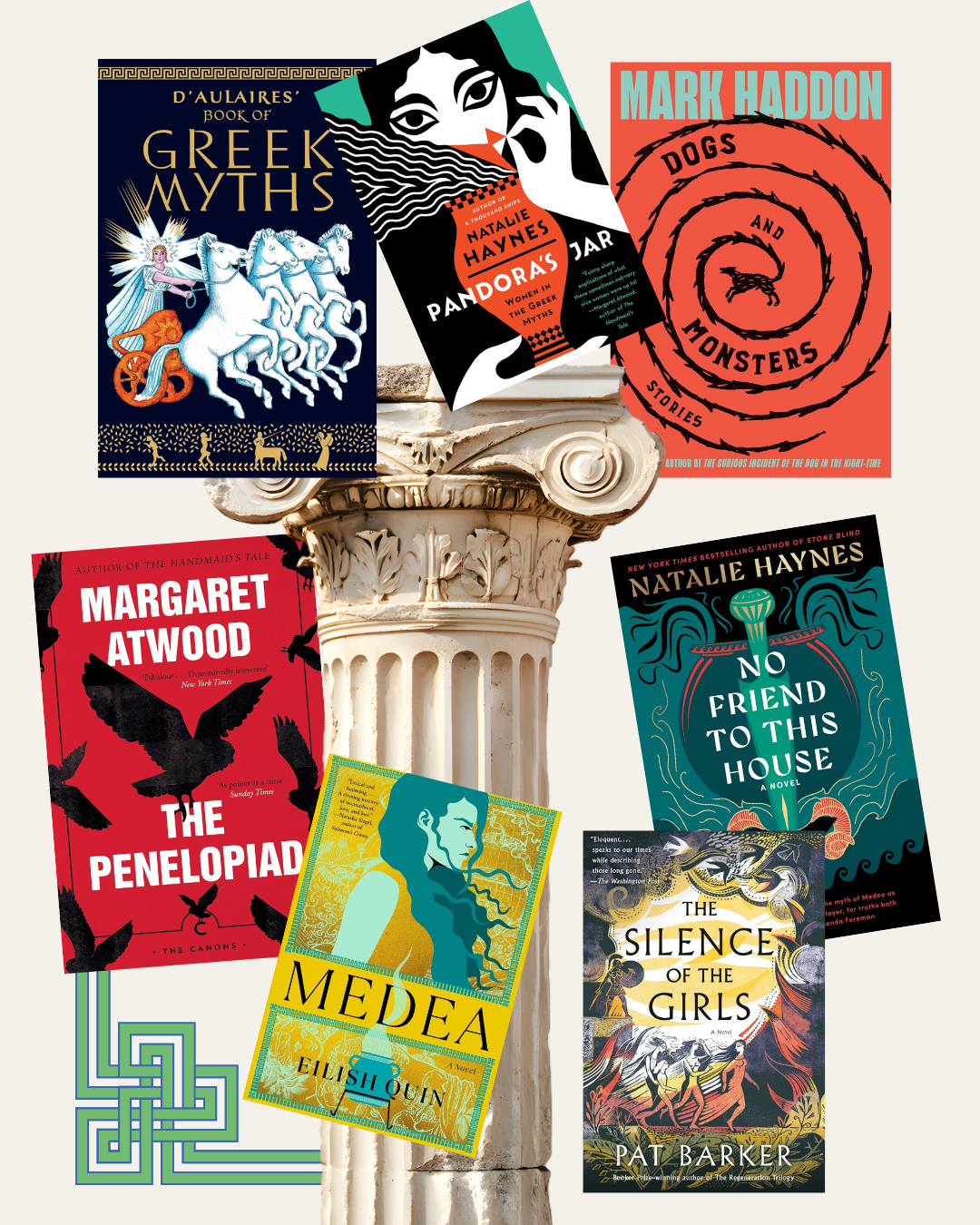
What to read first is your question. Maybe you grew up on Percy Jackson, and you want to level up. Or you watched The Odyssey and are hungry to dive into Greek Mythology reading, but you don’t want to get bogged down in boring details.
I am certain neither of us wants to waste our hard-earned cash on a book we won’t love.
That is why this list is filled with sure picks to help you fall in love with Character-Driven Greek Myths as an adult reader.
Let’s get to it then!
Circe by Madeline Miller — The Best Overall Place to Begin
In Circe, Madeline Miller takes a minor figure from Greek mythology and gives her a rich, unforgettable story of her own. Born into a powerful family of gods, Circe never quite belongs. When she discovers that she possesses a dangerous form of magic, she is exiled to a remote island, where she begins to understand her abilities—and herself.
Along the way, she encounters familiar mythological figures, including Hermes, Daedalus, the Minotaur, and Odysseus, but the novel’s heart remains Circe’s personal transformation.
This is a thoughtful, character-driven story about loneliness, power, motherhood, love, and a woman learning to define her life on her own terms, apart from others’ expectations. It is also one of the most approachable books on Greek mythology for beginners. It is the perfect book to get you started.
Reader connection: Best for readers who enjoy character growth, isolation, magic, motherhood, and women discovering their own strength.
Purchase Your Copy
The Song of Achilles by Madeline Miller — Best for an Emotional Character-Driven Story
In The Song of Achilles, Madeline Miller retells the story of Achilles through the eyes of Patroclus, an awkward young prince who is exiled from his home and sent to live in Achilles’ father’s court. Although the two boys seem very different, they form a deep friendship that grows into love as they train, mature, and eventually face the demands of war and destiny.
Familiar figures from the Trojan War appear throughout the novel, but the heart of the story lies in the complex relationship between Patroclus and Achilles.
This is a beautifully written, character-driven Greek mythology book that explores loyalty, ambition, sacrifice, and the painful cost of becoming a legend. (Prepare for tears)
Even if you know little about The Iliad, Miller makes this ancient story personal, approachable, and deeply moving.
Reader connection: Best for readers who want friendship, devotion, ambition, prophecy, tragedy, and an emotionally immersive story.
The stories vary in setting and style, but each explores mortality, love, moral choices, and what it means to be human—or to be treated as less than human.
Purchase Your Copy
Clytemnestra by Costanza Casati — Best for Readers Who Love Fierce, Complicated Women
I listened to the audio version of Clytemnestra and the narrator made the experience delightful. Listening is a great way to experience the emotion in a book.
In this, Costanza Casati reimagines one of Greek mythology’s most notorious women as a fiercely intelligent Spartan princess, devoted sister, loving mother, and transition to a powerful queen.
Raised to be strong in both body and mind, Clytemnestra refuses to quietly accept the roles chosen for her. But when ambition, marriage, war, and devastating loss reshape her life, she must learn how to survive in a world ruled by dangerous men.
Rather than presenting her as a simple villain, Casati delves deeper into the betrayals and grief that drive Clytemnestra’s legendary anger.
This page-turning, character-driven Greek mythology book is filled with complicated family relationships, political power, loyalty, and revenge.
Readers who love strong women and morally complex characters will find much more to Clytemnestra than the ancient stories usually reveal.
Reader connection: This may appeal especially to readers who enjoyed the family loyalties and power struggles in Jade City or the emotional intensity of The Sword of Kaigen.
Purchase Your Copy
Ariadne by Jennifer Saint — Best for Betrayal, Sisters, and Family Secrets
In Ariadne, Jennifer Saint retells the familiar story of Theseus and the Minotaur through the eyes of the women who are too often left in the background. Ariadne is a princess of Crete, the daughter of the powerful King Minos and the sister of the Minotaur, who was hidden inside the Labyrinth.
When the heroic Theseus arrives, she must choose between loyalty to her family and the chance to escape the dangerous life planned for her. The novel offers multiple points of view. It follows her younger sister, Phaedra, giving you another perspective on love, power, and the consequences of heroic ambition.
I loved this approachable Greek mythology retelling, which is filled with complicated family relationships, betrayal, strong themes of sisterhood, and women trying to build lives beyond the choices of famous men.
Reader connection: Best for readers who enjoy sisters, dangerous families, betrayal, and women discovering how little control they have within a hero’s story.
Character-Driven Greek Mythology Books That Give Women Their Stories Back
The Penelopiad by Margaret Atwood — Penelope Tells Her Side of The Odyssey
In The Penelopiad, Margaret Atwood gives Penelope the opportunity to tell her side of The Odyssey. Remembered as the faithful wife who waited twenty years for Odysseus to return, Penelope looks back from the afterlife and reveals a much more complex story of marriage, loneliness, survival, and living in a household overrun by ambitious men.
Written to reflect the original feel of a live production, her account is interrupted by the haunting voices of the twelve maids whose tragic fate receives little attention in the original epic. This book is short, clever, and often sharply funny; this retelling questions who gets remembered as a hero—and whose suffering is quietly pushed aside. Would you expect anything less from Atwood?
Reader connection: An approachable choice for beginners who enjoy intelligent female narrators, feminist retellings of Greek mythology, and familiar stories examined from a surprising new perspective.
The Silence of the Girls by Pat Barker — The Trojan War From Briseis’s Perspective
In The Silence of the Girls, Pat Barker retells the Trojan War through the eyes of Briseis, a queen whose city is conquered by the Greek army and who is taken captive by Achilles. The heroes remembered for their courage and glory look very different from the women living at the edges of their story. I loved the shift in perspective this book offers us as readers.
As Briseis struggles to survive, she observes the pride, rivalry, violence, and fragile loyalties shaping the Greek camp. Barker does not romanticize the realities of war, but she gives Briseis intelligence, dignity, and a voice in a story that once treated her as a prize.
Reader connection: This is a darker, character-driven Greek mythology book about survival, power, identity, and the women who carried the consequences of men’s heroic ambitions.
A Thousand Ships by Natalie Haynes — The Women Behind the Trojan War
In A Thousand Ships, Natalie Haynes shifts the focus of the Trojan War away from the celebrated warriors and toward the women who lived through its consequences.
Told through a collection of connected perspectives, the novel introduces us to queens, goddesses, wives, mothers, daughters, captives, and survivors—including Penelope, Cassandra, Clytemnestra, and the women of Troy.
Some voices appear briefly, while others return throughout the book, gradually revealing how one legendary war changed countless lives. Haynes brings intelligence, compassion, and flashes of humor to a story filled with senseless brutality, grief, courage, anger, and resilience.
Reader connection: This is a wonderful Greek mythology retelling for readers who enjoy multiple viewpoints and want to discover the women who were never merely background characters in the heroes’ adventures.
I, Medusa by Ayana Gray — A Familiar Monster Becomes the Main Character
In I, Medusa, Ayana Gray takes one of Greek mythology’s most recognizable monsters and lets us meet the young woman behind the legend. Medusa is caught between her own hopes and the selfish, often cruel games of the Olympian gods.
When she is punished for a crime she did not commit and her locks are transformed into snakes, she must decide whether to remain a victim or take control of the story being written about her.
I love Gray’s Medusa. She is angry, vulnerable, loving, and wonderfully complicated—not simply a creature waiting for a hero to defeat her.
Reader connection: Filled with heartbreak, power, identity, and righteous rage, this character-driven Greek mythology retelling is a strong choice for readers who enjoy bold heroines and familiar villains viewed from an entirely new angle.
Stone Blind by Natalie Haynes — Medusa’s Story From Multiple Perspectives
In Stone Blind, Natalie Haynes revisits the story of Medusa and asks a wonderfully uncomfortable question: Who is the real monster here? I listened to the audio narration and found it excellent.
Medusa is the only mortal in a family of immortal Gorgon sisters, and she grows up as a precious baby girl, surrounded by their fierce love and protection. After the gods’ heartless actions change her life forever, she becomes the feared figure we recognize from mythology.
But Haynes does not tell the story solely from Medusa’s perspective. Gods, mortals, monsters, and even objects add their voices, revealing how differently one legend can look depending on who is speaking.
I found this method of retelling her story clever, compassionate, and often unexpectedly funny.
Reader connection: This Greek mythology retelling explores power, blame, sisterhood, and the frightening ease with which an innocent woman can be turned into someone else’s monster.
Stone Blind or I, Medusa: Which Medusa Retelling Should You Read First?
If you are deciding between Stone Blind and I, Medusa, the biggest difference is how each author tells Medusa’s story.
Stone Blind uses a broad, nonlinear narrative that moves among Medusa, her sisters, Perseus, the gods, and several unexpected narrators. Natalie Haynes balances tragedy with sharp humor and clever observations about the gods’ absurd behavior.
I, Medusa, keeps much closer to Medusa through a first-person narrative, creating a more direct, intimate, and emotionally intense reading experience.
The two novels also portray Medusa differently.
In Stone Blind, she is a gentle mortal surrounded by the love of her immortal sisters, while the gods appear vain, careless, and frequently ridiculous.
In I, Medusa, readers follow a hopeful young woman as violence and betrayal push her toward becoming a powerful, morally complicated vigilante. The gods are less comic here; they represent dangerous authority and the devastating consequences of unchecked power.
So, which Medusa retelling should you read first?
Choose Stone Blind if you enjoy multiple viewpoints, dark humor, and seeing how several Greek myths connect.
Choose I, Medusa if you prefer one central character, a more straightforward origin story, and a raw exploration of identity, rage, and reclaiming power.
For readers who primarily love deeply character-driven Greek mythology books, I would begin with I, Medusa—but if you enjoy Natalie Haynes’s witty dialogue and layered storytelling, you may prefer Stone Blind.
Greek Mythology Books About Medea
Medea by Eilish Quin — A Character Study of Love, Power, and Becoming an Outsider
In Medea, Eilish Quin gives one of Greek mythology’s most feared women the chance to finally tell her full story.
Medea is a gifted sorceress, a princess of Colchis, and the granddaughter of the powerful Titan Helios—but her divine blood cannot protect her from the limitations placed on women. When Jason and the Argonauts arrive in search of the Golden Fleece, she is drawn into a dangerous adventure filled with magic, monsters, treacherous seas, and impossible choices.
Medea risks everything for Jason, only to discover that loving a hero can carry a terrible cost.
Reader connection: This book is dark, haunting, and deeply character-driven; this retelling does not excuse every choice Medea makes. Instead, it explores how love, betrayal, power, and fate helped create the woman history remembers as a monster.
No Friend to This House by Natalie Haynes — Medea and Jason Reconsidered
Women rule the story in No Friend to This House; Natalie Haynes returns to Jason and the Golden Fleece. Through the voices of Medea, goddesses, queens, mothers, and other women usually pushed to the edges of the legend, Haynes reveals the divine schemes and human sacrifices behind Jason’s heroic reputation.
At the center is Medea: powerful, intelligent, foreign, and deeply in love with a man whose ambitions will change both of their lives. Haynes brings her familiar wit and compassion to this dark story of love, vengeance, loyalty, and betrayal.
Reader connection: This layered Greek mythology retelling is an excellent choice for readers who enjoy multiple perspectives and morally complicated characters who refuse to fit neatly into the roles of hero or villain.
Medea as Villain, Victim, Mother, and Outsider
The best Medea retelling for a beginner depends on whether you want to experience her story through one intimate voice, several connected perspectives, or the historical sources behind the myth.
Which Medea Retelling Should a Beginner Read First?
A quick practical answer:
Choose Medea by Eilish Quin for an immersive character journey.
This novel stays close to Medea as she discovers her abilities, falls in love with Jason, and joins the quest for the Golden Fleece. It is the best starting point for readers who want to understand Medea as a complicated woman before judging the choices that made her infamous.
Choose No Friend to This House by Natalie Haynes for multiple perspectives.
This retelling places Medea within the larger story of Jason’s quest and lets many of the overlooked women and goddesses around it speak. Choose this one if you enjoy layered storytelling and want a broader view of how ambition, divine interference, and betrayal shape the legend.
Read the Medea chapter in Pandora’s Jar for historical and cultural context.
Natalie Haynes examines how ancient writers and later storytellers have portrayed Medea over time. This nonfiction option is perfect if you want to understand where the familiar version of her story came from—and why Medea may be far more complicated than the villain we inherited.
Greek Mythology Short Stories and Nonfiction for Beginners
Dogs and Monsters by Mark Haddon — Greek Myths in Short, Unexpected Stories
I like quirk and novelty in my reading selections. For a little variety, I offer you Dogs and Monsters. In it, Mark Haddon offers eight imaginative short stories that blend Greek mythology with contemporary life, dystopian settings, and other familiar legends.
Rather than simply retelling the adventures of famous heroes, Haddon turns his attention toward the mothers, monsters, animals, and overlooked characters standing at the edges of the original stories.
A Minotaur’s mother, an immortal man who continues to age, and the dogs involved in Actaeon’s terrible fate are all given new room on the page.
Reader connection: This thoughtful, sometimes unsettling collection is a strong choice for readers who enjoy Greek myths with a modern, unexpected twist.
Pandora’s Jar by Natalie Haynes — Meet the Women Behind the Myths
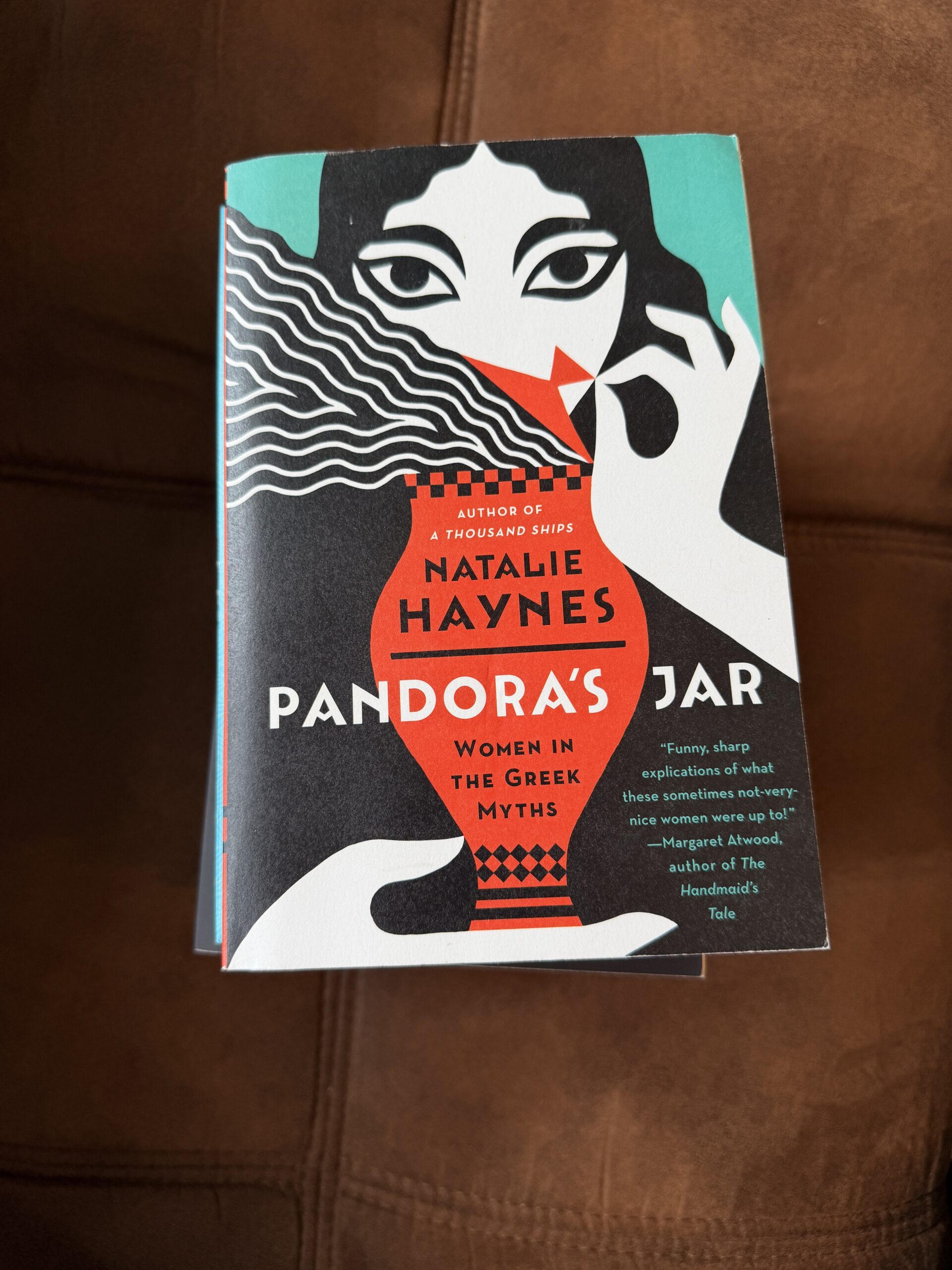
Pandora’s Jar is nonfiction rather than a novel, but Natalie Haynes makes exploring the ancient myths feel lively, approachable, and surprisingly entertaining. In a series of thoughtful essays, she examines how women such as Pandora, Medusa, Medea, Penelope, and Helen were portrayed in the earliest versions of their stories—and how writers, artists, translators, and popular culture have reshaped them over time.
Haynes looks beyond the simple labels of temptress, monster, villain, or faithful wife to uncover women who are far more interesting and complicated than we often remember.
This book makes a wonderful companion to modern retellings of Greek mythology because it helps readers recognize where familiar interpretations come from, what may have been lost in the retelling, and why these ancient women continue to fascinate us.
Should You Begin With a Retelling or a Greek Mythology Guide?
If you want to fan the flames of an inkling desire for more mythology, start with the retelling. Whether you want heartache, girl power, or brutal revenge, you will find it. Along with complex characters, with stories deeper than you imagined.
Once you are hooked, you can fill in your dark spots with a guide like Pandora’s Jar or another guide. This will help you feel confident making more complex selections based on the characters you want to learn more about. Who knows, you might be reading The History of Troy next year.
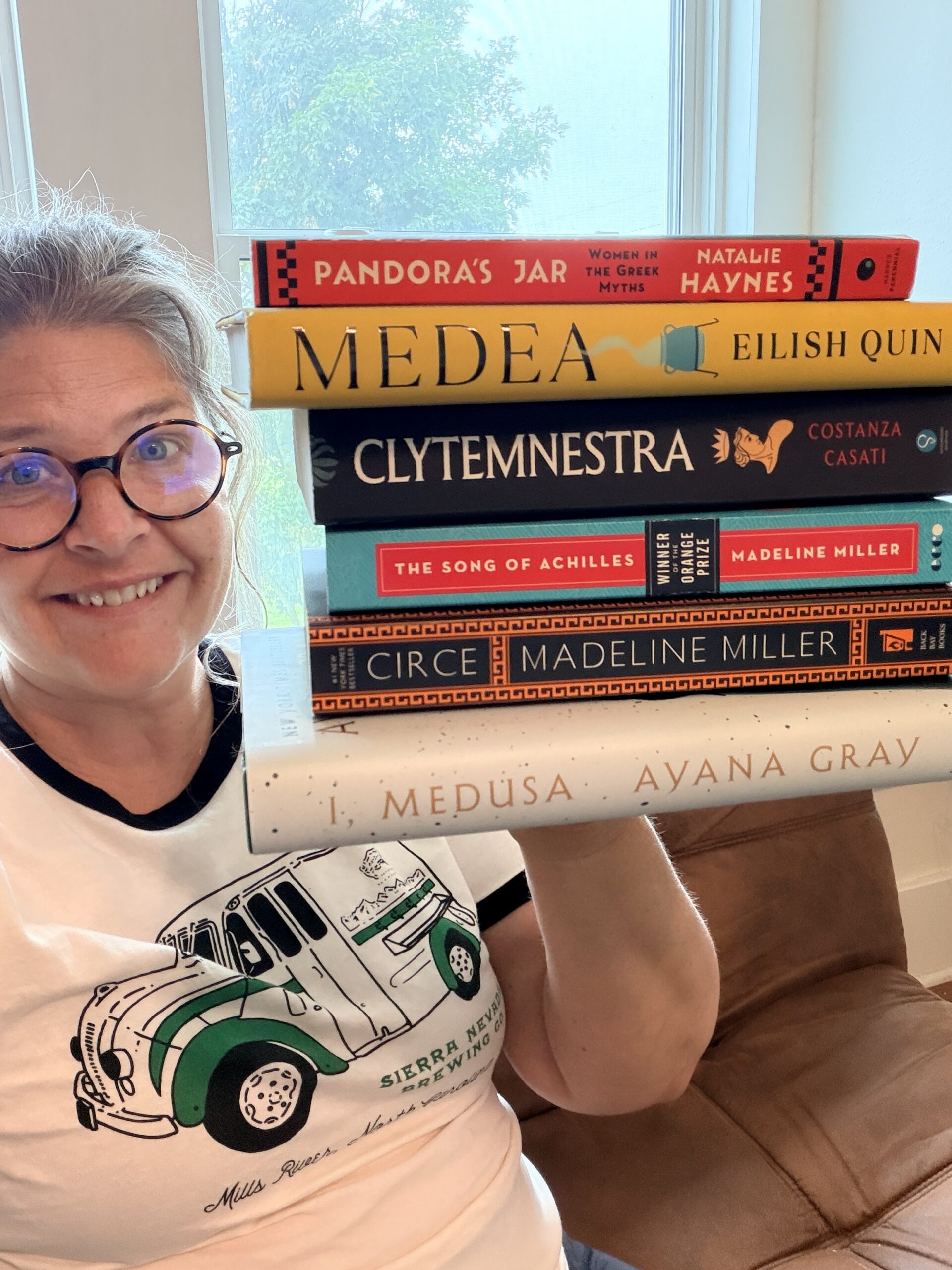
How to Choose Your First Greek Mythology Book
If You Want an Immersive Personal Journey
I recommend Circe or Clytemnestra. These stories focus on the main character and have fewer unfamiliar names to track.
If You Want a Story That Will Break Your Heart
Everywhere I look, readers recommend The Song of Achilles or The Silence of the Girls.
If You Love Morally Complicated Women
Start with Medea, Clytemnestra, or No Friend to This House.
If You Want Several Women’s Perspectives
For a more rounded perspective, or if you are a lover of multi-perspective books, choose A Thousand Ships or Stone Blind. I personally loved Stone Blind. The ending was a moment of clarity and surprised me.
If You Prefer Shorter Stories
I would recommend Dogs and Monsters or The Penelopiad for a quick read. These are great books if you tend to read in small chunks. These stories are short and self-contained in a chapter or two.
If You Want Mythology Explained Along the Way
You will find Pandora’s Jar a satisfying place to begin.
A Beginner-Friendly Greek Mythology Reading Order
A suggested order:
- Circe
- The Song of Achilles
- Clytemnestra
- Ariadne
- A Thousand Ships
- The Silence of the Girls
- The Penelopiad
- I, Medusa
- Stone Blind
- Medea
- No Friend to This House
- Dogs and Monsters
- Pandora’s Jar
This list is not in chronological order. Instead, it allows you to add layers to your understanding of the characters and their relationships as you read each book.
This layering will make you feel like a Greek Mythology expert without the studying.
A Note About Content in Greek Mythology Retellings
Greek Mythology is not for the faint of heart. This is a period of great violence, war, and callous inhumanity. The Mythologies contrast with the human experience. The stories of gods, living in immortality and opulence, offered a reprieve from the dark, cruel reality of life for the general population.
Why the focus on women in these modern retellings?
Women, in particular, were not considered intellectual equals or partners in social exploits. Society at large did not educate or elevate women, daughters, or wives, either in the public eye or in private life. Women were relegated to procreation and the keeping of estates. We understand that even in this time, there were women who broke these social standards. These modern retellings give space to imagine the untold stories of their lives.
This is why it is a wise choice to study history. In studying, we fill in the intentional blanks.
As you read, you build on your understanding of the culture, philosophy, and customs. In context, it should be noted that the tellings of Greek myths will contain content intended for mature readers.
Themes include:
- War and captivity
- Sexual violence
- Death of children
- Abusive relationships
- Grief and revenge
- Infidelity
- Graphic violence
Frequently Asked Questions About Greek Mythology Books
What Is the Easiest Greek Mythology Book for a Beginner?
Answer: Circe is a strong first choice because it combines recognizable myths with one clear character journey.
Do I Need to Read The Iliad Before The Song of Achilles?
Answer: Absolutely not! Knowing the original can add context, but it is not necessary.
Are Greek Mythology Retellings Accurate?
Greek Mythology is a retelling of older oral histories, layered over time throughout the Greek era. Myths have always existed in multiple versions.
Modern novels interpret the characters rather than providing a definitive historical account. I first learned these stories in a copy of Bulfinch’s Mythology. Many of these ancient stories are only a few pages in length.
These delightful characters offer an overwhelming temptation for storytellers throughout history, and modern writers are simply picking up a pen to add to the page.
What Should I Read After Circe?
I would recommend Clytemnestra, Ariadne, Stone Blind, and The Song of Achilles.
What Are the Best Greek Mythology Books With Strong Female Characters?
Clytemnestra, Circe, Medea, Stone Blind, I, Medusa, and A Thousand Ships. These are truly accessible books. The characters are larger than life in some ways, but also deeply human. These stories are very relatable for women. Circe is a beautiful retelling of a story we think we know. Stone Blind takes a villain and reveals a victim.
In each of these stories, we discover resilience, strength, and the love of sisterhood.
Why These Ancient Characters Still Feel So Familiar
Though Greek Myths are epic in scale and far-fetched in scope, each story tells a narrative of human experience. Jealousy, rage, mother love, sibling rivalry — these are elements of the human condition.
These emotions are a part of us.
These stories of gods and monsters give writers, both ancient and modern, a place to explore these emotions to their extreme ends.
These characters feel familiar because we have too felt loss, betrayal, and deception. We have loved, hid, and had to be fierce. Myths resonate because they are human at their core.
We love myths because when Midas is a bad father, we all see it. We collectively call him out and decry his behavior.
But in our everyday life, behavior can be far less polarizing. We feel the betrayals, the backstabbing, the challenges, but the scale is balanced with subtlety, strategy, and good Midwestern politeness.
Greek Myths give us heroes and monsters we can clearly understand. These modern retellings give us a chance to step back from our presupposed narratives and listen to the characters tell their stories, some for the first time.
Where to find character-driven Greek mythology books?
You can find all of these books and a few more at my Amazon storefront. Click the button below to see the list.